
What Google AI Overviews are and when they appear
Google AI Overviews (AIOs) replaced Search Generative Experience in May 2024. They appear as AI-generated answer panels above organic results for informational, comparison and how-to queries — roughly 15-20% of all searches as of 2025/2026. For Shopify stores, they appear most commonly on category research queries, product comparison queries, migration how-to queries, and SEO advice queries.
What Google pulls from to generate AIOs
Google's AIO generation draws from: (1) the indexable content of pages — headings, body copy, FAQ sections and structured lists; (2) structured data — particularly FAQPage, HowTo, Product and Article schema; (3) the established authority of the source domain on the topic. Pages that appear in AIOs are not always the top-ranked pages — structured, completeness-optimised pages can appear in AIOs even when they rank in positions 5-15.
The content structure Google AI Overviews prefer
AIOs consistently pull from pages that lead with a direct answer, use clear headings that match likely query variants, contain numbered or bulleted steps, include explicit FAQ sections, and avoid dense marketing prose. The page structure should mirror how a human expert would answer the question verbally — start with the conclusion, then explain the reasoning and caveats.
Which query types trigger AI Overviews for Shopify stores
Google AI Overviews are not triggered uniformly across all query types. Understanding which queries trigger AIOs for Shopify-relevant topics determines where to prioritise optimisation effort.
Category research queries trigger AIOs frequently. Queries like “best running shoes for overpronation”, “which espresso machine is best for home use” or “what are the most durable work boots” are comparison-oriented informational queries. Google interprets these as questions that benefit from an AI-synthesised answer rather than a list of links to click through.
How-to and migration queries are heavy AIO territory. “How to migrate from WooCommerce to Shopify without losing SEO”, “how to set up Shopify international pricing” and “how to fix duplicate product URLs in Shopify” all trigger AIOs because they have a structured, step-by-step answer that an AI can extract from well-formatted guide pages.
Comparison queries for products and platforms consistently trigger AIOs. “Shopify vs WooCommerce for a large catalogue”, “BigCommerce vs Shopify for B2B” and “[product type A] vs [product type B]” queries are among the most common AIO triggers for ecommerce-adjacent content.
Pure transactional queries — “buy running shoes”, “Shopify store shoes” — rarely trigger AIOs. Google does not synthesise an AI answer for queries where the user’s intent is clearly to purchase from a results page. This means the AIO opportunity for Shopify stores is primarily in informational and pre-purchase research content, not product listing pages.
The practical implication: optimising for AIOs should focus first on guide pages, comparison pages and category explanation content — not on product detail pages. Product pages benefit more from Product schema for ChatGPT Shopping and Google Shopping than from AIO optimisation.
The ranking vs AIO relationship
A page does not need to rank in position 1-3 to appear in a Google AI Overview. This is one of the most important — and most misunderstood — aspects of AIO optimisation.
Google’s AIO generation selects sources based on content completeness, structural clarity and topical authority — not purely on ranking position. A page ranking in position 7 that has excellent FAQPage schema, a structured HowTo implementation and a comprehensive FAQ section may appear in an AIO while the position-1 page does not.
This creates a real opportunity for Shopify stores competing against dominant authoritative sites in their category. A store ranking in positions 5-10 for its primary category queries can still achieve AIO visibility if it invests in content completeness and schema rather than pure link building.
The reverse is also true: high-ranking pages with thin content, no schema and no structured FAQ sections can be excluded from AIOs entirely, losing the brand visibility opportunity that AIO citation provides, even as they retain their organic ranking position.
Track AIO appearance separately from organic ranking. The two are correlated but not identical.
Technical requirements for Google AI Overview inclusion
The page must be indexed. This sounds obvious but Shopify stores often have indexation gaps on collection pages, older guide pages or blog posts that are relevant to AIO-triggering queries. Verify in Google Search Console that your priority content pages are indexed and not blocked by noindex, canonical mismatches or crawl errors.
Content completeness matters more than content length. A 600-word page that directly answers the primary question, covers the most important sub-questions and uses structured headings will outperform a 3,000-word page of marketing prose for AIO inclusion. Google’s AIO system is extracting specific sections, not rewarding overall word count.
Schema helps but does not determine inclusion alone. Pages with FAQPage schema are easier for Google’s system to identify as question-answering content. HowTo schema makes step sequences machine-readable. But schema on a thin or poorly structured page will not compensate for content quality gaps. Schema is most powerful when it marks up content that would earn citation even without the schema markup.
Page speed and Core Web Vitals are baseline requirements. Slow or unstable pages are harder for Google to render and index reliably. They are not specifically penalised for AIOs, but poor Core Web Vitals often correlate with other technical issues that reduce indexation confidence.
FAQPage schema implementation for Shopify
FAQPage schema is the highest-impact single schema type for Google AI Overview inclusion. It is straightforward to implement and directly maps to how Google’s AIO system identifies question-answering content.
The implementation is a JSON-LD block added to the <head> section of the page, or injected via Shopify’s additional_scripts section in the theme settings.
{
  "@context": "https://schema.org",
  "@type": "FAQPage",
  "mainEntity": [
    {
      "@type": "Question",
      "name": "Does Shopify automatically generate canonical URLs for collection pages?",
      "acceptedAnswer": {
        "@type": "Answer",
        "text": "Yes. Shopify automatically generates canonical URLs for collection pages and product pages. For products that appear in multiple collections, Shopify sets the canonical URL to the product's direct URL (/products/[handle]) rather than the collection URL (/collections/[collection]/products/[handle]), preventing duplicate content issues."
      }
    },
    {
      "@type": "Question",
      "name": "How many FAQ items should I include in FAQPage schema?",
      "acceptedAnswer": {
        "@type": "Answer",
        "text": "Three to five questions is the practical range. Fewer than three provides limited signal. More than five is permitted by Google but rarely adds citation value — AI systems extract the most relevant question-answer pair for any given query, not the full list."
      }
    }
  ]
}
For Shopify specifically: if your store uses a theme with Liquid templates, add the JSON-LD block to the relevant page template file (page.liquid, article.liquid or a custom template). For headless or theme-customised setups, inject the schema into the <head> via a script block in theme settings.
Write FAQ questions in the exact language buyers use in search. “What is FAQPage schema?” is a developer question. “Does Shopify automatically add FAQ schema to guide pages?” is a Shopify operator question. The closer the question matches actual search queries, the more likely the answer is pulled for AIO answers to those queries.
How to test manually for AI Overview inclusion
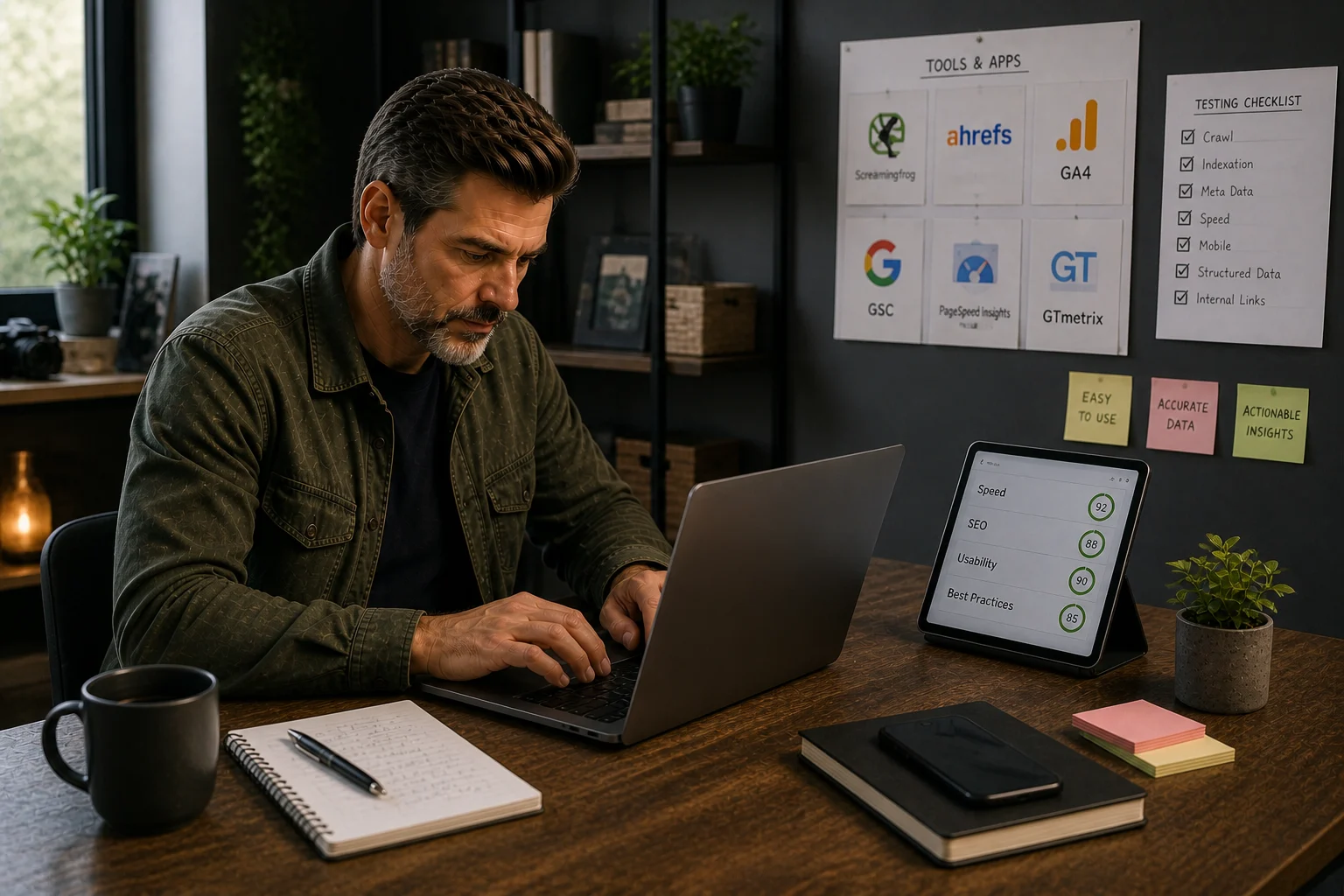
Manual testing is the most reliable method for checking whether specific pages appear in Google AI Overviews.
Testing protocol:
- Open Chrome in a private/incognito window and sign out of all Google accounts
- Go to google.com (or google.co.uk / your regional Google)
- Search for the target query
- Observe whether an AI Overview panel appears above organic results
- If yes: check whether your store is cited. Expand the AIO to see source URLs.
- Note which competitors are cited. Note what type of content they are citing (guide, collection, product).
Run the same test across 10-15 target queries. If you are appearing in AIOs, note which page types are being cited. If a competitor is appearing consistently for queries where you are not, inspect their cited pages for schema differences and content structure differences.
Limitations: AIO appearance can vary by location, login state, and time. A single test is not definitive. Run tests on multiple days and from multiple accounts before concluding a page is excluded.
Which Shopify page types appear most in AI Overviews
Guide and resource pages are cited most frequently by Google AIOs. A well-structured guide on “how to choose the right running shoe for marathon training” or “what to look for when migrating from WooCommerce to Shopify” maps directly to AIO-triggering informational queries.
Collection/category pages can appear in AIOs, but only when the collection description is substantive and specific. A 30-word generic collection intro will not be cited. A 200-word category explanation that covers what the collection includes, who it suits, how to choose and what differentiates options has AIO citation potential.
Product pages appear in AIOs primarily for comparison queries and evaluation queries — not for transactional searches. A product page that includes a detailed description, specifications, use-case guidance, and a FAQ section covering common buyer questions is more likely to appear in comparison AIOs than a product page with a standard description and no additional content.
Blog and article content performs well for AIOs when it directly answers specific questions. Shopify merchants who publish buying guides, how-to content and category explanations on their blogs are targeting the query types that most frequently trigger AIOs.
Why thin collection descriptions never appear in AI Overviews
The most common missed opportunity for Shopify stores is collection page content. Most Shopify collections have one of three content states: no description at all, a single generic paragraph that could apply to any similar store, or keyword-stuffed text that reads like a 2012 SEO article.
None of these get cited in AIOs.
Google’s AIO generation looks for content that genuinely answers the underlying question behind a shopping category search. A query for “best waterproof hiking boots” is asking: what makes a hiking boot waterproof, which brands make them well, what price range should I expect, what should I consider for my use case?
A collection description that says “We offer a great range of waterproof hiking boots from top brands” answers none of those questions. It will not appear in an AIO.
A collection description that says “Waterproof hiking boots use Gore-Tex or proprietary membrane technologies to keep feet dry in wet conditions. They are best suited for trails with standing water, stream crossings or prolonged rain exposure. Key considerations are membrane type, boot height (mid vs. high cut), sole grip pattern, and weight-to-durability ratio for your typical terrain” — that content answers real questions and has AIO citation potential.
Writing useful collection descriptions is the most under-invested Shopify SEO action with the highest compound return: it improves organic ranking, AI visibility and direct conversion simultaneously.
Writing FAQ sections that AIO systems pull from
The difference between FAQ sections that get cited and those that do not comes down to three qualities: question authenticity, answer directness, and answer completeness.
Question authenticity: write questions as real buyers and practitioners ask them, not as marketing prompts. “Why choose us?” is not a real FAQ question. “Does this schema implementation affect Shopify’s default breadcrumb markup?” is a real question a Shopify developer would ask.
Answer directness: the first sentence of every FAQ answer should be a direct response to the question. Not context-setting, not qualifications. “Yes, Shopify automatically generates canonical URLs for all product pages.” Then elaborate. AI systems extract the direct answer first — if it does not appear early, it may not be extracted at all.
Answer completeness: a complete FAQ answer covers the question without requiring the reader to click elsewhere. If the answer to the FAQ question is “it depends — see our guide”, that is not a citeable answer. The FAQ answer should be the guide. Keep it to 2-5 sentences — short enough to read at a glance, complete enough that clicking through is optional.
Combine FAQPage schema with good FAQ writing. The schema makes the Q&A machine-readable. The writing quality makes the AI willing to cite it.
Quick answer
Ecommerce content becomes easier for search engines and AI systems to understand when entities, evidence, page structure and source clarity improve together.
What you will do
- Clarify what the store sells and who it serves.
- Improve content that supports brand, category and product understanding.
- Create a repeatable AI visibility monitoring process.
What to check first
- Search Console for query evidence.
- Search and competitor research tools for entity evidence.
- Manual AI answer checks with logged prompts and dates.
- Structured data validators for product and article output.
Work through it in this order
- List the brand, product categories, use cases, materials, audience and location signals that matter.
- Check whether collection and product pages state those facts clearly.
- Add evidence: specifications, comparisons, FAQs, delivery/returns detail, reviews and trust information.
- Use internal links to connect guides, collections and products around the same entity.
- Track how the brand and competitors appear in search results, AI answers and citation-like mentions.
Real-world notes
- AI visibility does not rescue weak ecommerce pages. The underlying page still needs clear products, categories and evidence.
- Stores with vague collection copy often struggle because the page does not state enough facts to be confidently summarised.
- Do not optimise for AI answers at the expense of conversion. The page still has to sell.
Final checks
- Core entities listed.
- Collection pages explain category fit.
- Product pages include evidence.
- Trust details are visible.
- Internal links connect related pages.
- AI visibility checks are logged.
Watch-outs
- If a category has regulatory or safety implications, keep claims conservative and source-backed.
- If AI systems confuse the brand with competitors, strengthen naming, About, organisation schema and comparison content.
- If pages are thin, do not jump to schema first. Fix the visible content.
Use AI visibility tracking after the core Shopify SEO pages are already clear and useful.
Field questions
Do AI Overviews reduce organic clicks even when you appear in them?
Yes. Google's own data and third-party studies show that AIO presence reduces CTR from the organic results below them, including for the source pages cited. Being cited in an AIO drives some brand awareness but fewer direct clicks than appearing in position 1-3 organically.
Can Shopify product pages appear in Google AI Overviews?
Yes, but typically only for product comparison or evaluation queries rather than transactional queries. Google tends to show AI Overviews for research-phase queries like 'what are the best X for Y' rather than 'buy X online'.
Does schema markup guarantee inclusion in AI Overviews?
No. Schema is a signal, not a guarantee. Complete Product schema, FAQPage schema and HowTo schema all increase the probability of AIO inclusion by making content more parseable, but Google's selection also depends on authority, content quality and query relevance.
How do I know if my Shopify pages appear in AI Overviews?
Google Search Console does not yet report AIO impressions or clicks separately from organic results as of mid-2026. Manual testing with target queries is the most reliable method. Tools like SE Ranking, Semrush and BrightEdge are adding AIO tracking to their rank monitoring products.
Will Google AI Overviews replace my organic traffic?
Partially and selectively. Traffic from informational queries is most affected. Transactional queries — product searches with buying intent — show fewer AIOs. The best response is to make your content AIO-worthy while continuing to optimise for transactional ranking.