Collection descriptions should clarify the range
The job is not to add filler text. A collection description should help shoppers and search systems understand what the category contains, who it suits and how to choose.
Keep products visible
Do not push the product grid far down the page with a wall of copy. Use short top copy and deeper buying guidance lower on the page where useful.
Write for page intent
A parent category, modifier collection, brand collection and seasonal collection need different descriptions because they answer different shopper questions.
A collection description is not a keyword parking bay
Shopify collection descriptions help SEO when they make the collection easier to understand.
They do not help when they are generic paragraphs written only to hold keywords.
The best collection descriptions answer practical shopper questions:
- What products are in this collection?
- Who are they for?
- How should someone narrow the choice?
- What makes this range different from nearby collections?
- Which related category should the shopper visit next?
That is useful for visitors. It is also useful for search systems trying to understand whether the page deserves to rank for a category query.
If the collection is just a product grid with a vague label, the page is asking Google and the shopper to do too much guessing.
Start with the collection’s job
Different collections need different copy.
| Collection type | Description job |
|---|---|
| Parent category | Explain the range and link to useful subcategories. |
| Subcategory | Clarify the more specific product group. |
| Modifier collection | Explain material, size, use case, colour or compatibility. |
| Brand collection | Explain the brand range and why shoppers choose it. |
| Seasonal collection | Clarify timing, stock and campaign intent. |
| Merchandising collection | Support browsing, not necessarily SEO. |
Do not write the same style of description for all of them.
A “new in” collection might need almost no SEO copy. A “wide fit wedding shoes” collection probably needs clearer buying guidance, product evidence and links to adjacent choices.
For the broader page plan, use Shopify collection page SEO.
Keep the product grid early
The old SEO instinct was to add a large block of text at the top of the page.
That often makes ecommerce pages worse.
People arriving on a collection usually want to see products quickly. They may also need a short explanation to confirm they are in the right place.
A good pattern is:
- H1 that names the collection clearly.
- Short intro that clarifies the range.
- Product grid visible early.
- Filters that help shoppers narrow.
- Supporting copy lower down.
- FAQs and related links after the commercial experience.
That gives search systems enough context without turning the page into a blog post wearing a product-grid hat.
What to include in the top description
The top description should usually be short.
Aim to clarify:
- the product type;
- the main buyer need;
- important modifier or use case;
- stock/range depth where relevant;
- how to choose next.
Example:
Shop waterproof walking boots built for wet trails, winter commutes and long days outside. Compare lightweight, insulated and leather options, then use the filters to narrow by size, fit and terrain.
That is more useful than:
Our waterproof walking boots are the best waterproof walking boots for waterproof walking boots shoppers looking for waterproof walking boots online.
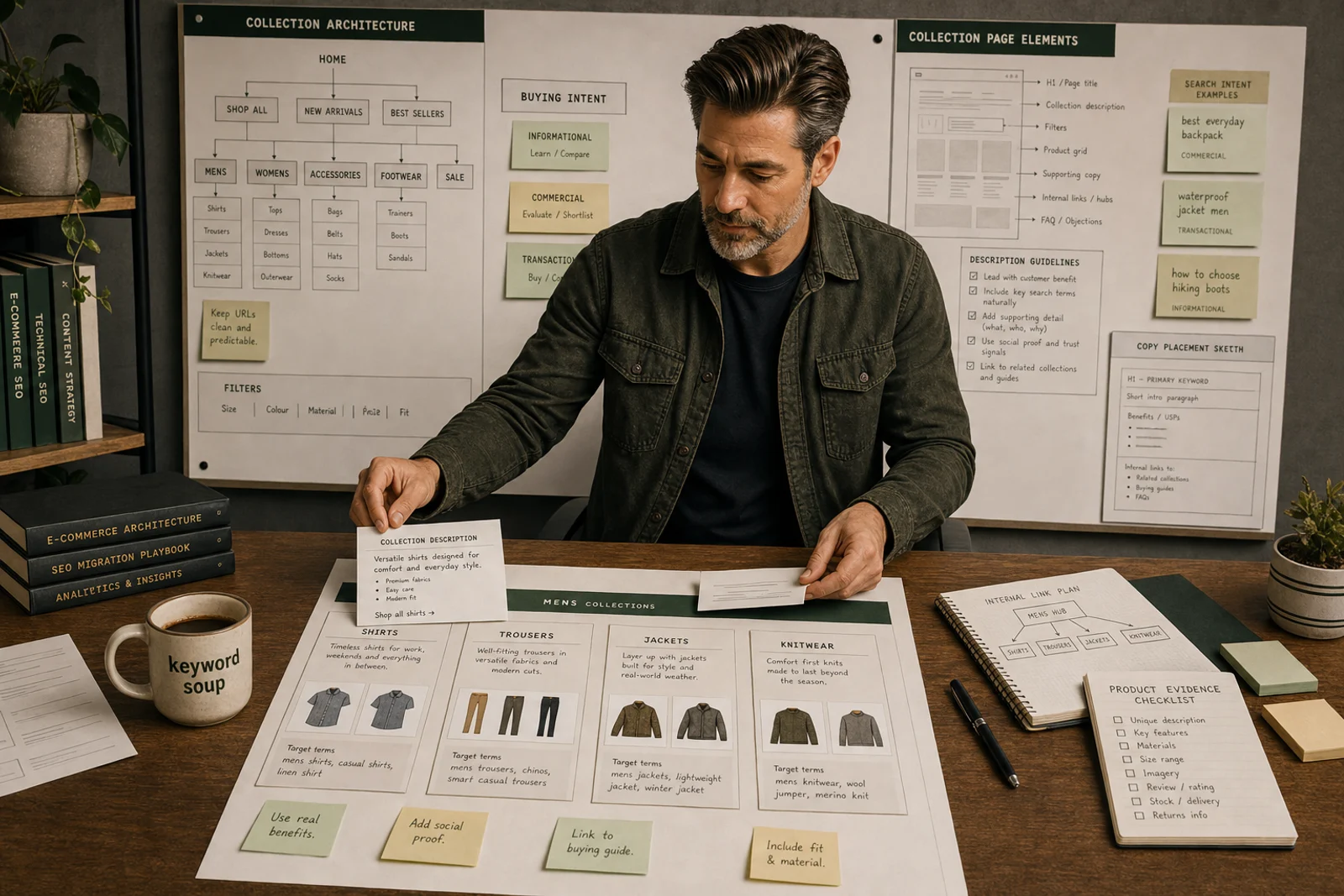
Keyword soup belongs in a mug, not above the product grid.
What to add lower on the page
Lower-page copy can do more work.
Use it for:
- buying guidance;
- material or fit explanations;
- links to related collections;
- links to guides;
- delivery or returns notes where relevant;
- product comparison criteria;
- FAQs;
- internal links to parent and child categories.
Lower-page content is especially useful when the category has real complexity.
For example, a collection for “running shoes” may need guidance on support, terrain, fit, cushioning and gait. A collection for “black socks” probably does not need an essay unless there is a specific product reason.
Avoid creating copy for collections that should not exist
Sometimes the problem is not the description.
The problem is that the collection should not be an SEO page.
Before writing, ask:
- Does this collection have distinct search intent?
- Does it have enough products?
- Is stock stable enough?
- Is it linked internally?
- Is it meaningfully different from similar collections?
- Would a shopper understand why this page exists?
If the answer is no, do not solve it by writing more copy.
You may need to consolidate the collection, keep it as a merchandising page, or use filters instead.
Use Shopify faceted navigation SEO before turning every modifier into a landing page.
Practical example
A store has these collections:
- Dresses
- Summer Dresses
- Linen Dresses
- White Linen Dresses
- White Summer Linen Dresses
The last page might sound like a tempting SEO target. But it only deserves collection treatment if:
- there is meaningful search demand;
- the store has enough matching products;
- the intent is distinct;
- the page can be linked naturally;
- stock will not disappear next week.
If not, use one stronger collection and filters.
The copy should support the structure, not justify a weak page.
Internal links make collection copy more useful
Collection descriptions should not be dead-end text.
They can link to:
- parent collections;
- child collections;
- related materials or use cases;
- sizing or buying guides;
- product comparison pages;
- relevant blog posts;
- high-value products where appropriate.
Use links where they help the shopper decide. Do not add a link block just because someone said internal links are good.
For a deeper linking plan, use Shopify internal linking.
What not to do
Do not paste the same paragraph across dozens of collections.
Do not hide the product grid under a long SEO essay.
Do not create a collection for every keyword variation.
Do not write copy that promises products the page does not contain.
Do not use FAQs to stuff keywords.
Do not optimise the description before deciding whether the collection deserves to exist.
Collection description template
Use this simple structure for priority collections:
- Name the product group clearly.
- Say who or what it is for.
- Mention the main selection criteria.
- Keep the top copy short.
- Add deeper buying guidance lower down.
- Link to related collections and guides.
- Answer real shopper questions.
The best collection descriptions are not long.
They are useful.
Quick answer
Shopify SEO becomes operational when the constraint is clear, the right page type is fixed, the output is tested and the commercial impact is reported.
What you will do
- Prioritise technical SEO work by page type and business value.
- Fix crawl, indexation, metadata, template, image and internal-link problems in the right order.
- Decide when a tool is needed and when native Shopify controls are enough.
What to check first
- Shopify admin for search listings, redirects, products, collections and theme settings.
- Google Search Console for indexing, queries and landing-page movement.
- GA4 or Shopify reports for commercial impact.
- Research tools for keyword, competitor and audit processes.
- TinyIMG where image handling is the repeated constraint.
Work through it in this order
- Choose the page type being fixed: collection, product, blog, page, filter, vendor or migration URL.
- Check crawlability, indexability, canonical, title, H1, internal links, schema and page speed.
- Compare Search Console queries with the page intent.
- Fix the template or content pattern before editing dozens of individual pages.
- Retest the page in a crawler, browser, structured data validator and Search Console where relevant.
- Record the change date, owner, expected impact and next review date.
Real-world notes
- Most Shopify SEO gains come from page architecture and template fixes, not from installing another SEO app.
- Collection pages usually carry the commercial opportunity; product pages usually supply evidence and conversion detail.
- A technical fix that is not tied to a page type and a commercial priority becomes backlog noise.
Final checks
- Page type selected.
- Primary query intent confirmed.
- Canonical and indexability checked.
- Title, H1 and meta reviewed.
- Internal links updated.
- Schema output checked.
- Image weight reviewed.
- Change logged for reporting.
Watch-outs
- Do not index every filter combination. Create clean collections for valuable facets instead.
- Do not change handles on ranking pages unless the redirect and internal-link update are ready.
- Do not trust app-generated schema until you inspect the final page output.
Use the Shopify SEO Audit Checklist, then move into the roadmap, URL structure or collection guide for the page type in front of you.
Field questions
Do Shopify collection descriptions help SEO?
Yes, when they clarify the category, product range and buying intent. Generic copy added only for keywords is unlikely to help and may weaken the page experience.
How long should a Shopify collection description be?
Use enough text to explain the collection without burying products. Short useful copy near the top plus deeper guidance lower on the page often works well.
Where should Shopify collection copy go?
Place concise clarifying copy near the top and put longer buying guidance, FAQs and related links below the product grid or in a lower content area.
Should every Shopify collection have a description?
Priority SEO collections usually should. Pure merchandising collections may not need long descriptions if they are not intended as search landing pages.
Can collection descriptions be duplicated?
Avoid duplicated descriptions across important collections. Similar products can still have distinct intent, selection criteria and internal links.
Should collection descriptions include keywords?
They should use natural search language, but the goal is clarity. If the copy reads like a keyword list, it is probably not helping shoppers.